What Flight 12 Actually Proved: Starship's Acceleration Profile, in Context
By David Gassier — May 24, 2026 — 13 min read
On May 22, 2026, Starship Flight 12 lifted off from SpaceX's Starbase facility in South Texas, debuting the next-generation Starship V3 stack from the site's newly completed second launch pad. The flight was not flawless, but it was highly consequential. One Super Heavy Raptor shut down during ascent, and Ship 39 lost one of its six engines on the way to space. The booster did not complete its planned boostback sequence and was not caught by the tower — splashing instead into the Gulf. But the ship reached space on a valid suborbital trajectory, deployed its Starlink test payloads, completed reentry exercises, and performed a controlled splashdown sequence in the Indian Ocean before toppling over and exploding as planned.
Predictably, much of the post-flight commentary focused on what did not work: the booster boostback issue, the skipped in-space relight, the lost ship engine, and the thermal-protection experiments. Those are real engineering questions. But they may not be the most important story.
The more interesting question is what Flight 12 revealed about the operating envelope SpaceX is designing toward: a massive, rapidly reusable vehicle that can carry unprecedented payload mass while keeping acceleration loads within a range compatible not just with satellites, but potentially with fragile cargo, infrastructure modules, and eventually humans.
An Underreported Data Point: The Acceleration Profile
One under-discussed data point in the flight is the acceleration profile. Public flight data has not been released in technical-grade detail as of this writing — the numbers in this section are estimates derived from livestream telemetry overlays and post-flight commentary, not from SpaceX-published datasheets. Treat them as analyst inferences, not verified facts.
With that caveat: Starship Flight 12's peak acceleration during ascent appears to have been in the ~3g range, consistent with a vehicle being throttled below what its thrust-to-weight could otherwise deliver. Reentry peak appears to have sat in the 2–3g range during the belly-flop attitude, with a brief 3–4g spike during the flip-and-burn maneuver. Total time above 2g, across the entire flight profile from liftoff to splashdown: somewhere on the order of a few minutes.
For context, here is the same metric across the four vehicles that matter for any honest comparison:
| Vehicle | Peak g during ascent | Peak g during reentry/landing | Total time above 2g | Designed for |
|---|---|---|---|---|
| Airbus A380 (long-haul cruise) | ~0.25g (climb) | ~0.15–0.3g (descent + braking) | 0 minutes | Paying passengers (any age, any health) |
| Starship V3 (Flight 12 profile) | ~3g (throttled) | ~2–3g (belly flop) + 3–4g (flip-and-burn, brief) | ~4 minutes | Eventually paying passengers (per S-1 Future Markets) |
| Crew Dragon (Falcon 9 launch) | ~3–4g (max-Q + late S2) | ~3–4g (reentry) + ~3g (splashdown peak) | ~8–10 minutes | Trained NASA astronauts |
| Artemis II / Orion (lunar return) | ~3–4g (SLS core stage MECO) | ~6–7g (skip reentry at ~11 km/s) | ~12–15 minutes | Trained NASA astronauts, post-lunar |
Sources: Flight 12 profile is an estimate inferred from public livestream telemetry overlays and post-flight commentary, not from SpaceX-published datasheets; A380 data from Airbus operating manuals; Dragon and Artemis numbers from NASA technical documentation and SpaceX Crew Dragon user guides.
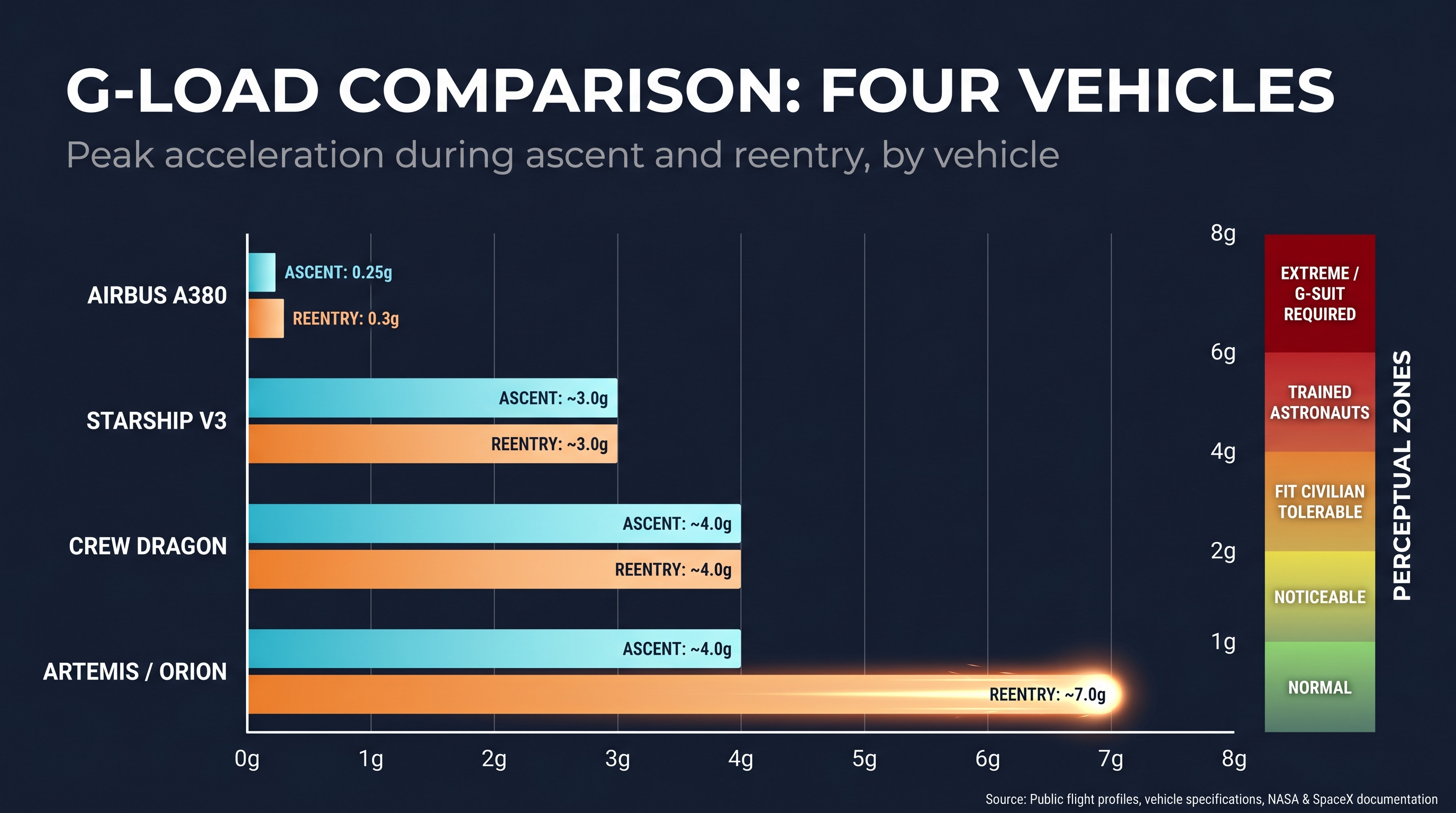
Read the table once. Then read it again with this question in mind: which of these four vehicles is being designed to carry someone who didn't train at Johnson Space Center for two years?
Only one. Flight 12, on initial analysis, is the most recent data point pointing in that direction.
What 3g Actually Feels Like
Numbers on a table don't convey the physiology. Let me anchor the comparison in something tangible.
0.3g is what you feel during a moderately steep aircraft climb or during routine highway driving when accelerating onto a freeway. Imperceptible discomfort. Conversation continues normally. Coffee stays in the cup.
1g is normal Earth gravity. You feel this right now.
2g is roughly the peak of a hard sports car launch (0–60 in ~3 seconds) or a steep rollercoaster pullout. Sustained, your arms feel heavy. Your face begins to feel like it's being pulled backward into the seat. You can still operate controls.
3g is what experienced fighter pilots describe as the threshold where you become acutely aware that your body has weight. Breathing requires conscious effort. Lifting an unweighted hand to your face takes deliberate force. You cannot stand. Most fit adults can sustain 3g for several minutes without losing consciousness, though it is unpleasant.
4g is sustained roller-coaster peak. Untrained civilians begin to experience gray-out (peripheral vision narrowing) within 30–60 seconds. Trained astronauts handle it routinely during launch, but it is the upper bound of what mass-market passenger transport could ever target.
6g is the threshold most fighter pilots reach during high-performance turns, with G-suits. Without a G-suit and breathing protocol, untrained passengers black out within seconds. Apollo astronauts experienced 6.4g on return from the Moon, briefly. Artemis II is expected to peak similarly during skip reentry from lunar velocity.
7g and above is reserved for ejection seats, military aerobatics, and the highest-performance experimental aircraft.
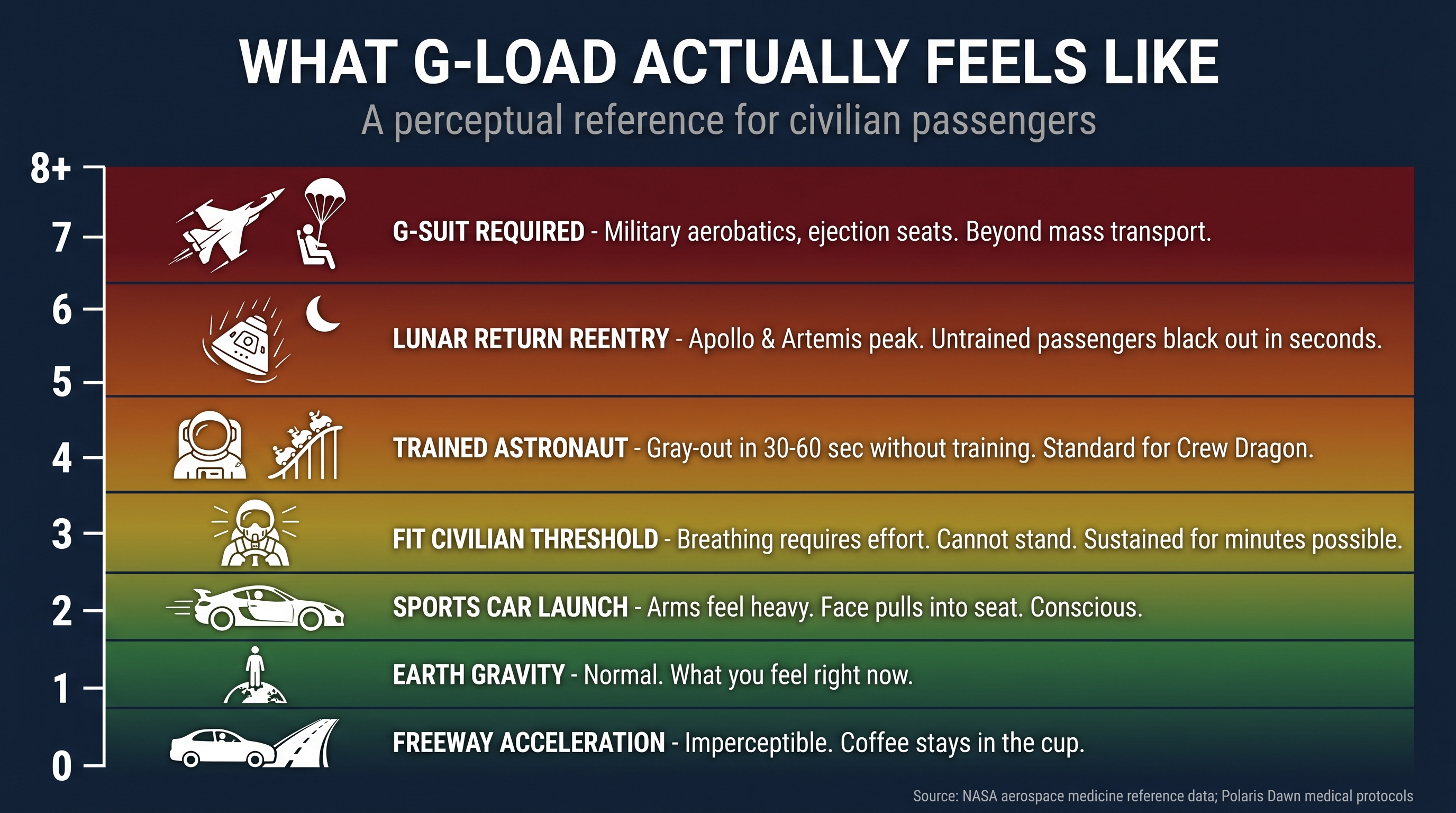
Now look back at the table. If the public estimates hold, Starship V3's peak g of ~3g is at the upper edge of "tolerable for fit untrained adults." Crew Dragon and Artemis are in the "trained astronaut only" zone. The A380 is in the "literally anyone" zone.
The profile suggests that Starship is not simply being optimized for maximum brute-force payload delivery. It is being engineered as a controllable transportation system. That is a meaningfully different design intent.
Why Lunar Return Is the Brutal Comparison
The most striking number in the table is Artemis's reentry g-load: 6–7g sustained for several minutes. Most readers assume rocket reentries are roughly similar across missions. They are not. The difference between Crew Dragon and Artemis is the speed of return.
A spacecraft returning from Low Earth Orbit (LEO) — like Crew Dragon — reenters at approximately 7.8 kilometers per second. The atmosphere decelerates the vehicle over a few minutes, producing peak g-loads in the 3–4g range.
A spacecraft returning from the Moon — like Apollo or Artemis — reenters at approximately 11 kilometers per second. The kinetic energy that has to be dumped is roughly twice that of LEO return (kinetic energy scales with velocity squared). The atmosphere must decelerate this energy in roughly the same window. The result is sustained g-loads of 6–7g, and a thermal environment several times more severe than LEO reentry.
Artemis II and beyond use a skip reentry profile — bouncing off the upper atmosphere once before final entry — partly to soften this g-load and spread the thermal load. Even with the skip, lunar return is the most physically punishing flight profile humans currently endure.
This matters for the Starship comparison because Mars return is fundamentally harder than lunar return. A return from Mars trajectory involves reentry velocities of 12+ km/s without aerocapture, or sustained aerocapture g-loads of 4–6g over much longer durations. The S-1's vesting milestone of "a permanent human colony on Mars with at least one million inhabitants" implicitly requires reentry profiles that the bulk of those one million people can survive.
That is an aerospace engineering problem on a different order of magnitude from anything currently flying.
Throttle Authority: Starship's Quietest Engineering Decision
If the ~3g ascent estimate is roughly right, the reason Starship can hold that profile — when its thrust-to-weight ratio at MECO could deliver substantially more — is the throttle authority of the Raptor engine family.
Older rocket engines (Merlin on Falcon 9, RS-25 on SLS, RL-10 on Centaur/ICPS) have throttle ranges typically between 60% and 100% of rated thrust. Below ~60%, combustion stability is difficult to maintain. Some engines, like the RS-25, cannot throttle below 67%.
Raptor 2 demonstrated a throttle range of approximately 40% to 100%. The Raptor configuration on V3, debuted on Flight 12, is publicly described as extending this envelope further, though detailed datasheet figures have not been released. Wider throttle authority means the vehicle can:
- Reduce thrust during early ascent, holding g-load to ~3g even as the vehicle gets lighter (less propellant mass) and could otherwise accelerate harder
- Throttle deeply during landing burn, enabling soft touchdown without requiring throttle-against-thrust solutions or descent-rate adjustments
- Hover and translate during the chopstick catch maneuver, an option no other operational launch vehicle has
The engineering tradeoff is clear: deeper throttle authority sacrifices some specific impulse efficiency in exchange for a vehicle that behaves like a controllable aircraft, not a controlled explosion.
That tradeoff only makes sense if the design target includes passengers who haven't trained for the experience. For a cargo-only vehicle optimized for delta-V, you would not pay the efficiency cost of wide throttle range. You would burn full-thrust all the way and let the cargo deal with whatever g-load resulted.
Starship appears to be paying that cost. Flight 12, on first analysis, is consistent with that direction.
The S-1's Quietest Disclosure
Article 3 in this sequence walked through the public SpaceX S-1 filing and surfaced the prospectus's "Future Markets" list. The list includes one item that, in light of Flight 12's acceleration profile, deserves a closer read:
"Future Markets: Point-to-point terrestrial travel · Space tourism · In-orbit manufacturing · Passenger and cargo transport to the Moon and Mars · Energy production on the Moon and Mars · Manufacturing capabilities on the Moon and Mars · Asteroid mining."
Source: SpaceX Form S-1, prospectus summary, p. 11.
"Point-to-point terrestrial travel" is listed first. That's the market where you take a Starship from New York to Tokyo in 35 minutes, suborbital. It is the only one of these markets where the customer is the kind of person who currently buys a first-class ticket on an A380.
This market has exactly one engineering precondition: an acceleration profile that consumer-class passengers can tolerate without preflight medical screening and G-suit training. Flight 12 is the first publicly-observable flight of V3 whose telemetry estimates are consistent with engineering toward that profile.
The S-1 disclosing point-to-point terrestrial travel as a Future Market is therefore not aspirational marketing. It is the natural extension of an engineering program that has already chosen, in hardware, to optimize for civilian g-tolerance. The vesting milestones in Musk's pay package — "1 million inhabitants on Mars" and "100 terawatts of orbital data center compute" — likewise require vehicles that can be flown by the broad population, not just trained astronauts.
This is the chain of inference Flight 12 made visible:
Throttle authority → gentler ascent g-load → civilian-tolerable profile → point-to-point + Mars colony viability → the $28.5 trillion TAM the S-1 claims.
Every link in that chain is an engineering choice. Each is, in principle, observable in flight data. Flight 12 produced the first publicly-observable V3 telemetry consistent with the first link.
The Algorithm, Applied to Passenger Comfort
The S-1 formally defines Musk's first-principles engineering framework, called "The Algorithm":
- Make less dumb (question every requirement)
- Delete (remove parts and processes that aren't strictly needed)
- Optimize (simplify what remains)
- Accelerate (speed up iteration)
- Automate (last, only after deletion and optimization)
Applied to passenger comfort, The Algorithm yields a specific design conclusion. Step 1: question whether high g-loads are actually a requirement of spaceflight, or a historical accident of expendable rocketry that prioritized payload-to-orbit ratio over passenger experience. Step 2: delete the engineering decisions that produced the historical g-load floor. Step 3: optimize the remaining design — engine throttle range, structural mass distribution, aerodynamic control surfaces — for a smoother profile. Step 4 and 5 follow.
The Saturn V and Space Shuttle (and SLS, which inherits Shuttle-era engines) all carry the historical assumption that astronauts will tolerate 3–6g sustained g-loads because they are trained astronauts. Starship's design is questioning that assumption. The wide-throttle Raptor, the belly-flop reentry attitude, the flip-and-burn maneuver, the chopstick catch — all are engineering decisions that only make sense if you reject the historical g-load floor.
Flight 12 is the latest data point in this rejection.
What This Means for Who Flies Starship
If Starship continues on its current acceleration trajectory, the populations of plausible passengers expand in this order:
- Trained astronauts and military test pilots (already qualifying for Crew Dragon and would qualify for any vehicle)
- Fit civilians with brief medical clearance (the SpaceX/Polaris Dawn precedent for orbital tourism)
- General population point-to-point passengers, with screening but not training (the S-1's stated future market)
- Mars colony passengers, including children, elderly, and people with chronic conditions (Musk pay package milestone of 1 million inhabitants)
The aerospace industry currently serves population 1 with Dragon/Soyuz, and approximately nobody with Artemis (which is built for trained crew only). Population 2 was demonstrated by Polaris Dawn in 2024 and a handful of subsequent flights. Populations 3 and 4 do not exist as customer categories yet — but the engineering decisions visible in Flight 12 are the precondition for them to exist.
This is the deepest implication of an acceleration profile that very little public coverage has analyzed: Starship appears to be the first launch vehicle whose design is observably oriented toward carrying passengers who don't and won't train as astronauts.
The competitive implication is significant. Blue Origin's New Glenn is targeting cargo and crew under traditional astronaut-tolerance assumptions. SLS/Artemis is engineered around 6g lunar return. China's Long March 9 is a heavy-lift cargo vehicle. None of them currently exhibit the throttle-authority and acceleration-throttling choices that Starship has made. None of them are credibly positioned for the point-to-point terrestrial travel market or the Mars-colony passenger market.
If those markets develop on the timeline the S-1 implies, the addressable customer base of Starship is structurally different from every other launch vehicle currently in development. That is not a competitive advantage measurable in dollars per kilogram to orbit. It is a competitive advantage measurable in who can be a customer at all.
The Operator's Takeaway
Flight 12 was not just a test of a new vehicle. It was a continuation of a sustained engineering bet that runs through every visible design decision of the Starship program: that the future of human spaceflight is mass transport, not heroic exploration. Mass transport requires acceleration profiles closer to passenger aviation than to traditional rocketry. Flight 12 demonstrated the next step on that gradient.
At Digital4.Ai, we work with operators building AI-driven systems where the most consequential design decisions are the ones that look unremarkable in isolation but determine the shape of the customer the system can serve. SpaceX's choice to engineer the V3 Raptor configuration for wider throttle authority — at a measurable specific-impulse cost — looks like a marginal engine-design decision. It is actually the choice that determines whether Starship can ever carry your grandmother to Tokyo.
The same pattern repeats in every operational system. What gets engineered reveals who the system is being built for. Reading a system's quiet engineering decisions tells you more about its customer roadmap than reading its marketing.
Read Starship's acceleration profile that way. It tells you who will fly.
Sources and Method
Flight 12 launched on May 22, 2026 from Starbase Pad 2. Acceleration figures cited in this article are estimates derived from livestream telemetry overlays and post-flight commentary by SpaceX and independent observers (May 22–24, 2026). The author has not derived these numbers from raw telemetry data; they are analyst-grade estimates consistent with the visible flight profile, not measurements. Definitive flight data has not been published by SpaceX in technical-grade detail as of the date of this article. Readers should treat the specific numeric values for peak g-load and sustained intervals as approximations to be revised when authoritative data becomes available.
Airbus A380 acceleration figures are from Airbus operating manuals and standard commercial aviation flight envelopes.
Crew Dragon ascent and reentry g-load data is from SpaceX's published Crew Dragon User Guide and NASA Crew-1 through Crew-8 mission documentation.
Artemis/SLS/Orion g-load figures are from NASA's Artemis Mission Architecture documentation and Lockheed Martin Orion technical references.
Raptor engine throttle authority is from public SpaceX presentations and conference statements by Elon Musk and engineering leadership; specific V3 Raptor configuration figures are based on post-flight commentary and have not been formally published in datasheet form.
This is editorial commentary, not engineering documentation. No safety, design, or operational claims are made or implied.
This is Article 6 in the SpaceX content sequence. Read Article 3: How to Read the SpaceX S-1 for the primary-source context on the $28.5 trillion TAM and the "Future Markets" list, and Article 2: Starship and Colossus Are the Same Story for the underlying execution-velocity thesis.