Your Code Is Being Shared With Big Tech — Here's Why That Matters
By David Gassier — February 12, 2026 — 8 min read
Your Code Is Being Shared With Big Tech — Here's Why That Matters
Reading time: 8 minutes
The Tool Your Developer Uses Has a Hidden Cost
If you've hired a developer — freelancer, agency, or in-house — there's a near-certainty they're using AI to help write your software. GitHub's own data shows that over 77% of developers now use AI coding assistants (GitHub, 2024). Tools like GitHub Copilot, ChatGPT, and Claude have become standard.
That's not a bad thing. AI dramatically improves productivity, code quality, and speed.
But here's what most business owners don't realize: every time a developer types your business logic, your proprietary process, or your competitive advantage into one of these tools, that information is sent to servers owned by Microsoft, OpenAI, Google, or Anthropic.
Your code. Your ideas. Their servers.
What Actually Happens When Developers Use Cloud AI
Let's make this concrete. Say you hire a developer to build an app that automates your quoting process — the special pricing logic that gives you an edge over competitors.
When that developer uses GitHub Copilot:
- Your code is sent to Microsoft/OpenAI servers for processing
- The AI generates suggestions based on patterns it learned from millions of other projects
- Your business logic now exists on infrastructure you don't control
The same applies to ChatGPT, Claude, Gemini, and virtually every popular AI coding tool.
What the Terms of Service Actually Say
Most cloud AI providers state they don't "use your data to train models." But the fine print varies:
- GitHub Copilot Business: Doesn't train on your code, but your code is processed on Microsoft Azure servers. It's transmitted, processed, and returned.
- ChatGPT: OpenAI's terms state that API usage data isn't used for training — but the free tier and Plus plans may use your inputs to improve models unless you opt out.
- Claude: Anthropic states they don't train on API data, but inputs are processed on their infrastructure.
Even in the best case — where providers genuinely don't train on your data — your proprietary information is still transmitted to and processed on servers you don't own, in data centers you can't audit, under terms of service that can change.
Why This Matters for Your Business
Trade Secrets Lose Legal Protection When Shared
Under the Defend Trade Secrets Act (DTSA) and Uniform Trade Secrets Act (UTSA), a trade secret must be subject to "reasonable measures" to maintain its secrecy. Sending proprietary algorithms, pricing logic, or business processes to third-party AI servers may undermine that legal protection.
If you ever need to defend your intellectual property in court, opposing counsel could argue that transmitting it to cloud AI services demonstrated a failure to maintain secrecy.
Compliance Requirements
For businesses in regulated industries — healthcare (HIPAA), financial services, legal — sending client data or proprietary processes through cloud AI may create compliance violations. Even if the code itself isn't regulated, the business logic it implements often is.
Competitive Exposure
Your quoting algorithm, your inventory optimization, your customer matching logic — these are competitive advantages. They shouldn't exist on servers shared with millions of other users.
The Alternative: Air-Gapped AI Development
At Digital4.Ai, we built The Vault specifically to solve this problem.
The Vault is our private development environment where AI models run entirely on our own local hardware. No internet connection. No cloud APIs. No data leaving our infrastructure.
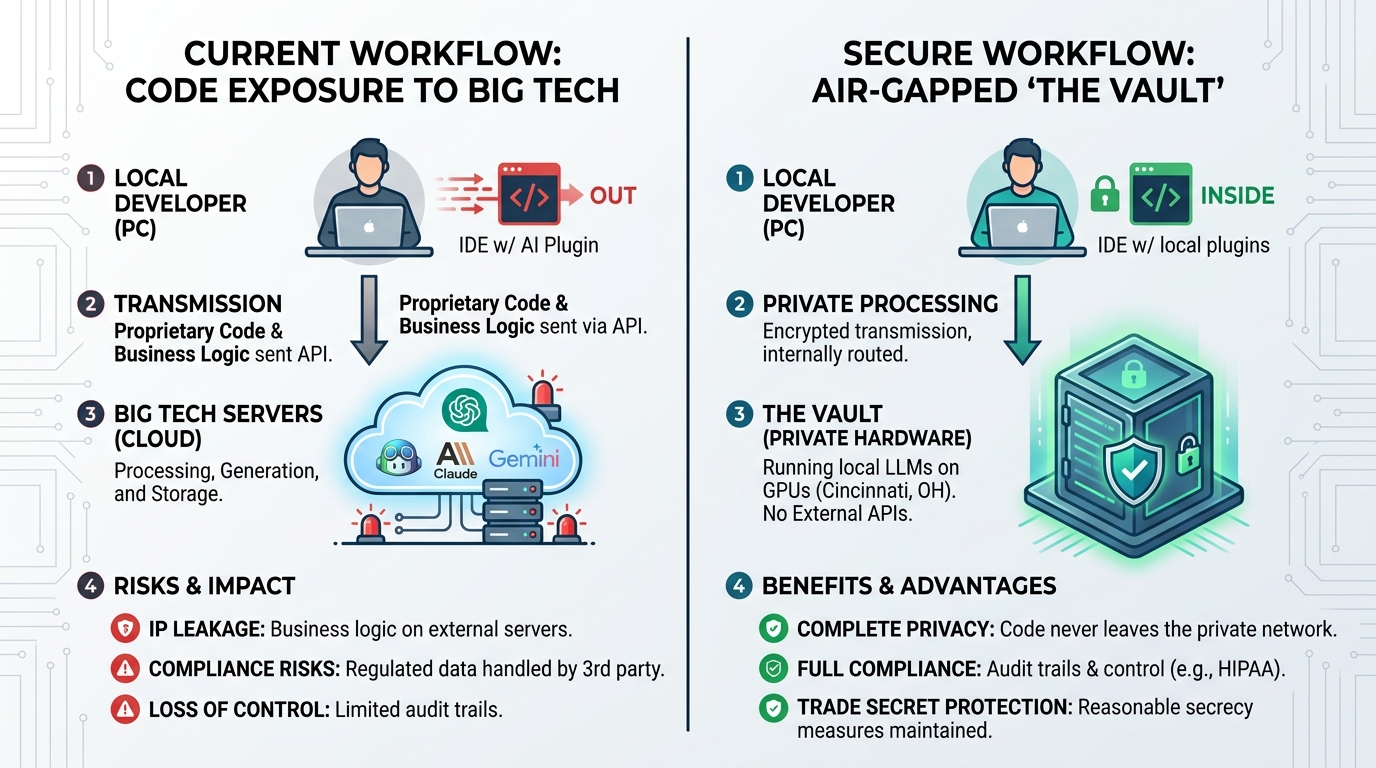
Here's what that means in practice:
How The Vault Works
- Local AI models: We run large language models (the same technology behind ChatGPT and Copilot) on our own GPU-equipped machines in Cincinnati, OH
- Air-gapped processing: During active development, your project data is processed on machines physically disconnected from the internet
- Zero cloud exposure: Your code, your business logic, and your data never touch Microsoft, OpenAI, Google, or Anthropic servers
- Encrypted storage: All project files are stored on encrypted drives with restricted access
What You Get
The same AI-powered development speed and quality that cloud tools provide — but with complete confidentiality. Your software is built faster and smarter, without your intellectual property leaving our hands.
Who Needs This?
Not every project requires this level of protection. But if any of the following apply to your business, private development isn't optional — it's essential:
- Proprietary processes that give you a competitive edge
- Compliance requirements (HIPAA, financial regulations, legal confidentiality)
- Trade secrets you'd need to defend legally
- Client data that you're contractually obligated to protect
- Simple peace of mind — you'd rather not wonder who has access to your code
The Bottom Line
AI-assisted development is the future. It produces better software, faster. The question isn't whether to use AI — it's whether to trust your business's most valuable ideas to servers you don't control.
You don't have to choose between speed and privacy. The Vault gives you both.
Ready to build something? Get a free consultation to discuss your project — no commitment, no pressure. Or learn more about how The Vault works.
References
GitHub. (2024). The State of the Octoverse 2024. Retrieved from https://github.blog/news-insights/octoverse/octoverse-2024/
Defend Trade Secrets Act, 18 U.S.C. § 1836 (2016).
Uniform Trade Secrets Act § 1(4) (1985).
Published: February 2026