Your AI Has Amnesia — And It's Costing You More Than You Think
By David Gassier — April 12, 2026 — 9 min read
Your AI Has Amnesia — And It's Costing You More Than You Think
The difference between an AI tool and an AI employee isn't intelligence — it's memory. And most systems are designed to forget.
The Question Nobody Asks Their AI Vendor
Imagine hiring an employee who, every morning, walks into the office having forgotten everything from the day before. Every client conversation. Every decision. Every preference you've shared. Every lesson learned.
You'd fire that person by lunch.
And yet — that's exactly how most AI systems work. Every session starts fresh. Every conversation is a blank slate. The tool that spent three hours learning your pricing strategy yesterday? It has no idea what you sell today.
We've gotten so used to this limitation that we stopped questioning it. But here's the thing: when an AI operates as an employee — handling your clients, managing your operations, making judgment calls on your behalf — amnesia isn't a quirk. It's a liability.
The real question isn't "How smart is your AI?" It's: "What does your AI actually remember about your business? And who controls that memory?"
The Amnesia Economy
The AI industry has a dirty secret: memory is treated as an afterthought.
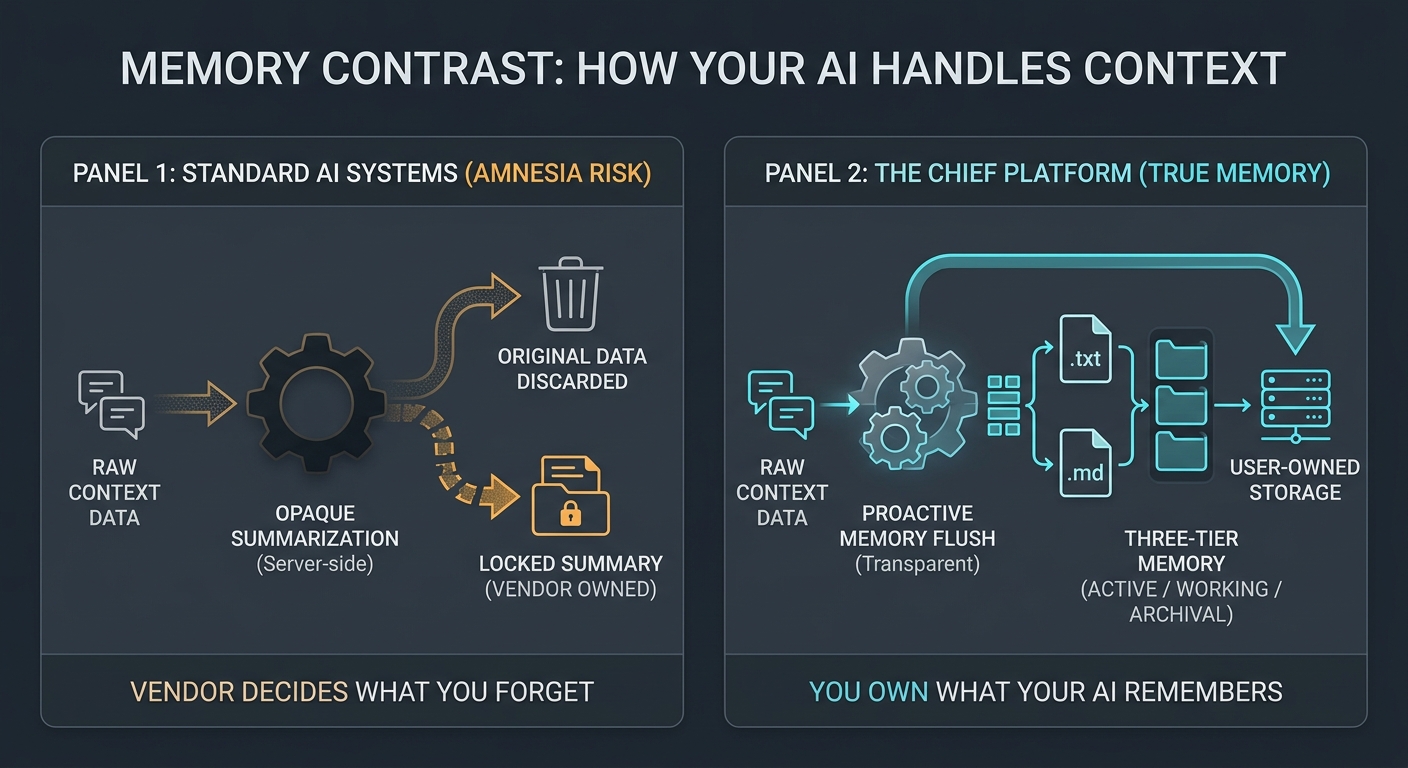
ChatGPT's memory system stores snippets — short bullet points extracted from your conversations. It decides what matters. You get limited visibility into what it retained, and almost no control over how those memories shape future responses. It's a black box that occasionally surfaces a fact you mentioned three months ago, with no explanation for why it remembered that and forgot something more important.
Coding assistants like Claude Code and GitHub Copilot use a technique called compaction — when the conversation gets too long, the system generates a summary and discards the original messages. Anthropic's own documentation confirms: "The model specified in your request is used for summarization. There is no option to use a different model for the summary." The system decides what to keep. The system decides what to discard. You never see the summary. You can't edit it. You can't audit it.
Think about what that means in practice: the most consequential decision your AI makes isn't the email it drafts or the report it generates. It's the decision about what to remember and what to throw away. And in most systems, that decision happens behind closed doors.
For a coding assistant, that might mean losing the context about why you chose a specific architecture — leading to suggestions that contradict decisions you already made. Annoying, but recoverable.
For an AI employee managing your business operations? The stakes are fundamentally different.
The Lock-In Problem Nobody Warned You About
In March 2026, LangChain — the most widely adopted AI agent framework — published a piece titled "Your Harness, Your Memory" that sent ripples through the developer community. Their CEO Harrison Chase shared a telling anecdote: an internal email assistant his team had built accumulated months of learned preferences. When it was accidentally deleted, recreating it from the same template produced a noticeably worse experience. All the learned behaviors — tone, timing, priorities — gone.
"Without memory, your agents are easily replicable by anyone who has access to the same tools. Memory transforms a generic AI into a personalized system that improves over time."
The article outlined a spectrum of memory lock-in risk that should concern every business leader:
Level 1 — Mild: Stateful APIs that store your conversation history on the provider's servers. Want to switch models? Your context doesn't travel with you.
Level 2 — Concerning: Closed systems where memory formats are proprietary and undocumented. Even if data technically exists on your side, it's useless outside that vendor's ecosystem.
Level 3 — Dangerous: Full agent-as-a-service platforms where everything — including your AI's long-term memory — lives behind a proprietary API. Zero visibility. Zero ownership. Zero portability.
LangChain's analysis noted that some systems generate encrypted compaction summaries that are completely unusable outside their ecosystem. Letta CTO Sarah Wooders put it bluntly: "Asking to plug memory into an agent harness is like asking to plug driving into a car."
The implication is clear: the more your AI learns about your business, the harder it becomes to leave. Memory creates stickiness that raw model access never could. And some vendors are counting on exactly that.
Why This Matters More Than You Think
In February 2026, the Harvard Business Review published a piece arguing that context has become the decisive competitive advantage in the AI era. When every company has access to the same models, the same tools, and the same vendor ecosystem, what differentiates you is your organizational context — the workflows, patterns, judgment calls, and institutional knowledge that make your business yours.
That argument has a corollary that most people miss: if your AI's contextual understanding of your business is locked inside a vendor's proprietary system, your competitive advantage belongs to them, not you.
This isn't a theoretical risk. Regulatory frameworks are catching up fast. The EU AI Act, NIST AI Risk Management Framework, and ISO 42001 all hit enforcement milestones in 2025-2026. A common thread across all of them: documented accountability for AI decisions. If an AI agent makes a judgment call on your behalf — prioritizing one client over another, scheduling a task, recommending a strategy — you need to be able to trace why it made that decision.
Now ask yourself: if your AI's memory is an opaque summary generated server-side by your vendor, how do you audit that? How do you trace a decision back to the context that produced it?
You can't. And that's exactly the problem.
A Different Approach: Memory You Can See, Own, and Audit
When we built The Chief — our AI employee platform — we made an early architectural decision that shaped everything: memory is a first-class system, not a feature bolted on after the fact.
Here's what that means in practice:
Three Tiers of Memory
The Chief maintains context across three layers, each serving a different purpose:
Active Memory — The current conversation, system instructions, and relevant context loaded at session start. This is what the AI is actively "thinking about" right now. It includes your company identity, communication style, and recent interactions.
Working Memory — Daily notes, curated long-term memories, intelligence briefs, and research files. These persist across sessions on dedicated storage and are retrievable through semantic search. When The Chief needs to recall something from last week — a decision, a client preference, a research finding — it queries this layer using natural language.
Archival Memory — Complete conversation logs, activity records, and older memory files stored indefinitely in your database. The full record. Searchable. Exportable. Yours.
The critical difference: every layer is stored as plain text files that humans can read, inspect, and edit. Not encrypted summaries. Not proprietary data structures. Not JSON blobs trapped behind an API. Markdown files. On storage you control.
Intelligent Compaction — Not Just Summarization
Every AI system must eventually deal with context limits. The question is how.
Most systems use mechanical compaction: when the conversation reaches a token threshold, a summarization model generates a compressed version and discards the originals. It's efficient. It's also how important nuance gets permanently lost.
We do it differently. The Chief proactively manages its own context, flushing important information to durable files at natural transition points — not when a technical threshold forces it:
- After concluding a topic — Before moving on, conclusions and decisions are saved. If automatic compaction triggers later, the important stuff is already safe.
- After completing research — Raw research generates massive intermediate context. Once conclusions are extracted, findings are saved to files and the conversation references the saved artifact instead of carrying the full analysis.
- Before complex multi-step work — A "recovery point" is saved, ensuring continuity even if automatic compaction occurs mid-task.
And when automatic compaction does trigger? We use a full-capability model for summarization — the same model that powers the main conversation. The temptation in this industry is to use a cheaper, faster model for compaction to save costs. We deliberately chose against this because compaction is the highest-stakes cognitive task an agent performs. A model that misses nuance during compaction creates compounding information loss.
The reasoning behind a decision matters more than the decision itself. A lesser model might preserve "we chose monthly billing" but lose "because the client expressed strong preference for simplicity over features, citing their team's limited technical bandwidth." That lost context means revisiting settled decisions. It means your AI employee asking the same questions twice. It means the slow erosion of trust.
The Traceability Layer
Here's where it gets powerful — and where our approach diverges most sharply from the mainstream.
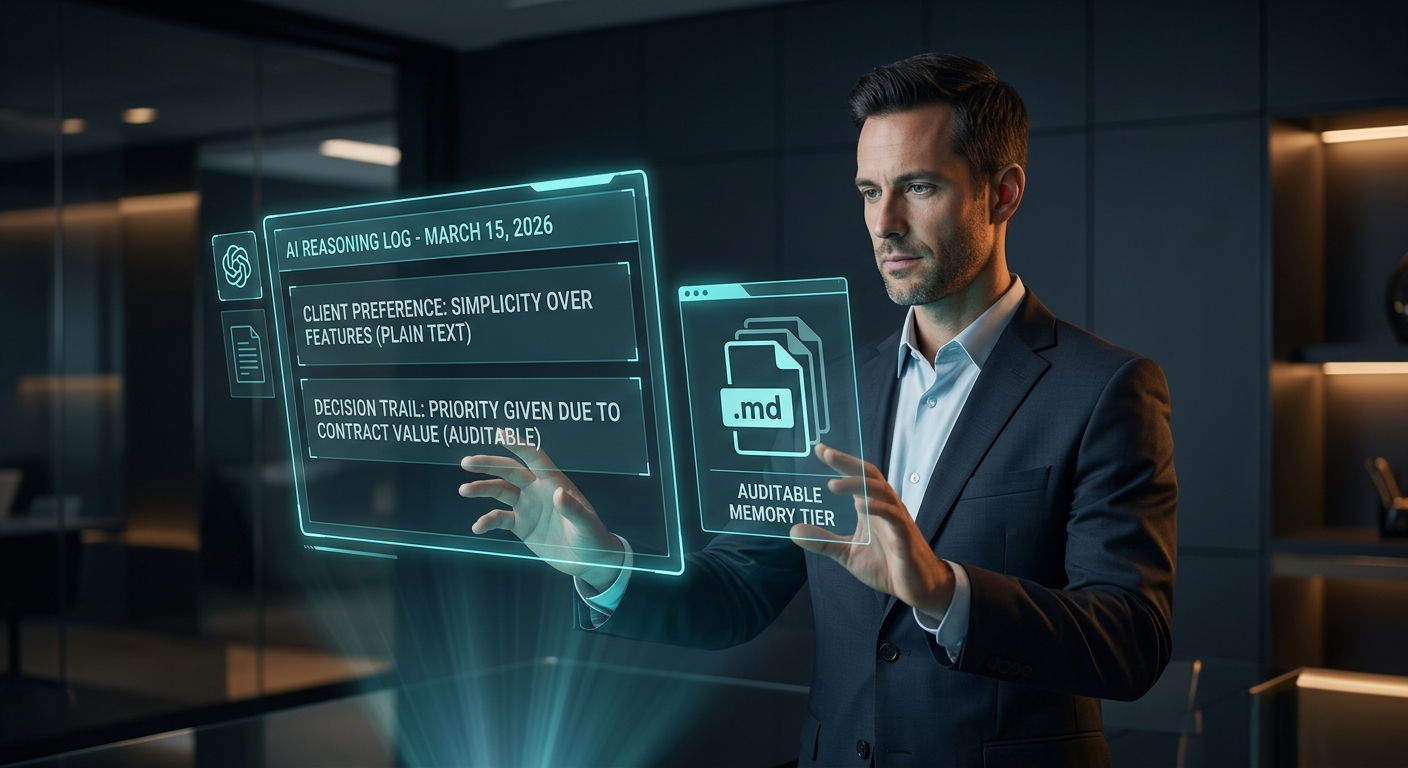
Because memory is stored as readable files, backed up to your database, and synced across sessions, every decision The Chief makes is traceable. You can:
- See exactly what your AI remembers — Open the Memory tab in Mission Control and read the daily notes, long-term memories, and intelligence briefs in plain text.
- Understand why a decision was made — Trace back through conversation logs and memory files to find the context that informed a judgment call.
- Audit the AI's knowledge state at any point in time — What did The Chief know on March 15th? Pull the memory files from that date. It's right there.
- Correct and evolve the memory — Found something wrong? Edit the file. The Chief picks up the correction in its next session.
You don't have to use any of this. The system works autonomously — your Chief handles its own memory management, proactively saves important context, and gets smarter over time without any intervention from you. Most customers never touch the Memory tab.
But when something happens — when you need to understand why The Chief prioritized a particular client, or why it recommended a specific strategy, or why it flagged an issue — the full chain of reasoning is there. No black boxes. No "trust us, the AI knows what it's doing."
For businesses operating under regulatory scrutiny, for professionals who need documentation of AI-assisted decisions, for anyone who simply wants to understand their AI employee: this isn't a nice-to-have. It's the difference between a tool you use and a system you can trust.
Memory Is the Moat
There's a deeper strategic reality here that Harrison Chase articulated perfectly: memory is what transforms a generic AI into your AI.
Any vendor can spin up a chatbot with the same underlying model. The API calls are identical. The capabilities are identical. On day one, every AI assistant is interchangeable.
But on day ninety? After accumulating three months of learned preferences, client insights, business patterns, communication nuances, and institutional knowledge? That agent is irreplaceable — not because the technology is unique, but because the accumulated context is.
The Harvard Business Review's argument about context as competitive advantage applies directly: your AI's understanding of your business — the patterns it's learned, the preferences it's absorbed, the judgment it's developed — that's your moat. And the question every business leader should ask is: who actually owns that moat?
If your AI's accumulated intelligence lives on someone else's servers, in someone else's proprietary format, governed by someone else's retention policies — then the answer, uncomfortably, is: not you.
We built The Chief on a simple principle: your AI's memory belongs to you. You can export it. You can inspect it. You can take it with you. And you can sleep at night knowing that if something goes wrong, the full record exists in a format you can actually read.
What This Means for Your Business
If you're evaluating AI solutions — whether it's an assistant, an agent, or a full AI employee — here are the questions you should be asking:
"Can I see what the AI remembers about my business?" If the answer involves proprietary dashboards, encrypted summaries, or "we don't expose that," walk away.
"What happens to my AI's learned context if I switch providers?" If the answer is "you'd have to start over," understand that's by design.
"Can I audit the AI's decision-making process?" If your AI handles anything with regulatory, financial, or client implications, you need a paper trail. Not a chat log — a decision trail.
"Who performs the memory summarization, and can I control it?" Server-side compaction by your vendor means your vendor decides what your AI forgets. That should give you pause.
"Is the memory format open and portable?" Proprietary formats mean proprietary lock-in. Open formats mean freedom.
An Employee That Remembers
The Chief isn't just an AI tool. It's an AI employee that learns your business, remembers your preferences, and gets sharper every day — with full transparency into how and why.
- Three-tier memory architecture that preserves context across sessions, days, and months
- Intelligent compaction that prioritizes why decisions were made, not just what was decided
- Full traceability — every memory, every decision, every piece of context is readable, auditable, and exportable
- Open format, no lock-in — your AI's memory is stored as plain text, backed up to your database, owned by you
- Autonomous operation — works without your involvement, but always available for inspection when you need it
Your business deserves an AI that doesn't just respond intelligently — one that knows you. That remembers the conversation from three weeks ago. That understands why you made the decisions you made. And that gives you full visibility into its own reasoning.
References:
- Chase, H. (2026). "Your harness, your memory." LangChain Blog.
- Murty, R.N. & Kumar, R. (2026). "When Every Company Can Use the Same AI Models, Context Becomes a Competitive Advantage." Harvard Business Review.
- Anthropic. (2026). "Compaction — Claude API Docs." platform.claude.com.
- Wooders, S. (2026). Cited in LangChain memory ownership analysis. Letta.
- NIST AI Risk Management Framework (2025). AI decision accountability requirements.
- EU AI Act (2025-2026). Enforcement milestones for AI transparency and auditability.