Agent as a Service: The $1 Trillion Shift NVIDIA Says Is Already Here
By David Gassier — March 20, 2026 — 11 min read
Agent as a Service: The $1 Trillion Shift NVIDIA Says Is Already Here
Innovation Lab: AI Technology — Part 4 Published: March 2026 | Reading time: 12 minutes
TL;DR: At GTC 2026, NVIDIA CEO Jensen Huang declared that every SaaS company will become an AGaaS (Agent as a Service) company. This isn't hype — it's a fundamental shift in how businesses will operate. AI agents that act autonomously on your behalf are replacing software you click through manually. But agents that can act can also leak data, break compliance, and make unauthorized decisions. Enterprise-grade sandboxing isn't optional — it's the foundation. Here's what AGaaS means, why it matters, and how to adopt it without a seven-figure budget.
This is Part 4 of our Innovation Lab: AI Technology series. In Part 3, we explored why AI needs NVIDIA — the hardware, the CUDA ecosystem, and the $10 billion bet that created the AI revolution. This article picks up where that story left off: what happens now that AI agents are ready to work.
The Quote That Should Make Every Business Owner Pay Attention
At NVIDIA's GTC 2026 conference in March, Jensen Huang said something that landed differently than the usual tech keynote buzz:
"Every single SaaS company will become an AGaaS company."
AGaaS. Agent as a Service.
He didn't say it casually. He framed it as an inevitability — the same way every company eventually needed a website, then a cloud strategy, then a mobile app. Huang drew a direct line through computing history:
- Every company needed a Linux strategy (the operating system era)
- Every company needed an HTTP strategy (the web era)
- Every company needed a Kubernetes strategy (the cloud-native era)
- Now, every company needs an OpenClaw strategy (the agentic AI era)
OpenClaw — the open-source framework NVIDIA backs for building AI agents — is, in Huang's words, "the operating system for personal AI." A natural-language operating system where you don't click buttons. You tell an agent what you need, and it acts.
This isn't a product announcement. It's a thesis about where all of software is going.
What Is AGaaS? (And What It Isn't)
Let's cut through the acronym.
SaaS (Software as a Service) gives you tools. You log into a dashboard, click through menus, fill out forms, export reports. The software helps, but you do the work.
AGaaS (Agent as a Service) gives you outcomes. You describe what needs to happen, and an autonomous AI agent does the work — monitoring your channels, responding to customers, triaging requests, following up, escalating when it's unsure, and reporting back.
The difference in practice:
| SaaS | AGaaS | |
|---|---|---|
| What you get | A tool to use | An agent that acts |
| Who does the work | You (or your team) | The agent (with your oversight) |
| How you interact | Click through dashboards | Give instructions in plain language |
| Availability | When you're logged in | 24/7, every channel, every timezone |
| Learning curve | Training manuals, onboarding | Tell it what you need — it adapts |
| Cost model | Per-seat licensing | Per-outcome or flat fee |
What AGaaS is NOT:
- Not a chatbot. Chatbots answer questions from a script. Agents make decisions, take actions, and learn from context.
- Not a copilot. Copilots suggest; you still click "accept." Agents execute — within boundaries you define.
- Not a replacement for all humans. Agents handle the repetitive, time-sensitive, high-volume work. Humans handle judgment, strategy, and relationships. The best AGaaS implementations make this boundary crystal clear.
Why Now? Three Forces Converging
1. The Process Layer Gap
According to VentureBeat's March 2026 enterprise AI report, 85% of companies want to deploy AI agents — but only 19% actually use multi-agent systems. The gap isn't technology. It's process.
Most AI agent platforms give you a blank canvas: here's an LLM, here's an API, go build something. But agents without defined processes, boundaries, and escalation rules are dangerous. They hallucinate. They overpromise. They take actions they shouldn't.
The companies that crack AGaaS aren't just deploying models — they're shipping process. Every agent needs a defined personality, domain knowledge, communication boundaries, and escalation rules before it talks to a single customer.
2. Open Models Are Finally Good Enough
When we wrote about why AI needs NVIDIA in October 2025, the open model landscape was promising but uneven. Six months later, NVIDIA's Nemotron family has changed the equation.
Nemotron 3 models are fully open-source — weights, training data, and recipes — licensed for commercial use with no royalties or revenue share. The Nano model (30 billion parameters, only 3 billion active at a time) runs on a single consumer GPU. The Super model (120 billion parameters) handles multi-agent reasoning tasks that rival frontier closed models.
This matters because AGaaS companies don't need to send every customer's data to OpenAI or Anthropic. You can run inference locally, on your own hardware, for your most sensitive workloads. The economics of AGaaS just shifted from "enterprise-only" to "any business with a GPU."
Jensen predicted this shift in token economics: tiers from free to $150 per million tokens, with every engineer eventually getting an annual token budget alongside their salary. The cost of intelligence is collapsing. The question isn't whether you can afford AGaaS — it's whether you can afford not to adopt it.
3. Enterprise Security Finally Has a Standard
OWASP released the Agentic Security Top 10 in late 2025 — the first industry-standard security framework for autonomous AI agents. It introduces the Least Agency Principle: give agents only the permissions they need, nothing more.
NVIDIA followed with NemoClaw at GTC 2026 — an enterprise-grade security platform built on OpenClaw that adds process-level sandboxing for AI agents. Every agent interaction runs inside an isolated environment with explicit policies on file access, network access, and data handling.
This is the piece that was missing. AGaaS without security is a liability. AGaaS with enterprise sandboxing is a competitive advantage.
4. The Biggest Players Are Shipping Agents — Not Copilots
This isn't just NVIDIA. In March 2026, Anthropic launched Claude Cowork Dispatch — a personal AI agent that runs on your desktop, manages your emails, organizes your files, generates reports, and lets you trigger tasks from your phone while your computer works in the background. It integrates with Gmail, Slack, Google Calendar, and over 8,000 apps via Zapier.
Read that again: Anthropic — the company behind Claude, one of the most advanced AI models on the planet — didn't ship another chatbot. They shipped an agent. One that acts autonomously on your behalf.
But here's the distinction that matters for your business: Cowork Dispatch is a personal productivity agent. It handles your tasks on your computer. It's AI for you.
What it doesn't do is face your customers. It won't answer your support tickets at 2 AM. It won't qualify leads on Telegram while you sleep. It won't follow up on cold prospects with your brand voice across every channel.
That's the difference between a personal agent and a business agent — between AI that helps you work and AI that works for your business. Both matter. But if you're an SMB owner, the one that moves the revenue needle is the one talking to your customers 24/7.
The Security Problem No One Wants to Talk About
Here's the uncomfortable truth about AI agents: an agent that can act on your behalf can also act against your interests.
If your agent can read customer emails, it can leak customer data. If it can access your CRM, it can modify records incorrectly. If it can respond to inquiries, it can make commitments you never authorized.
Most AGaaS platforms today operate on trust: "Don't worry, the model is aligned." That's not security. That's hope.
What enterprise-grade agent security actually looks like:
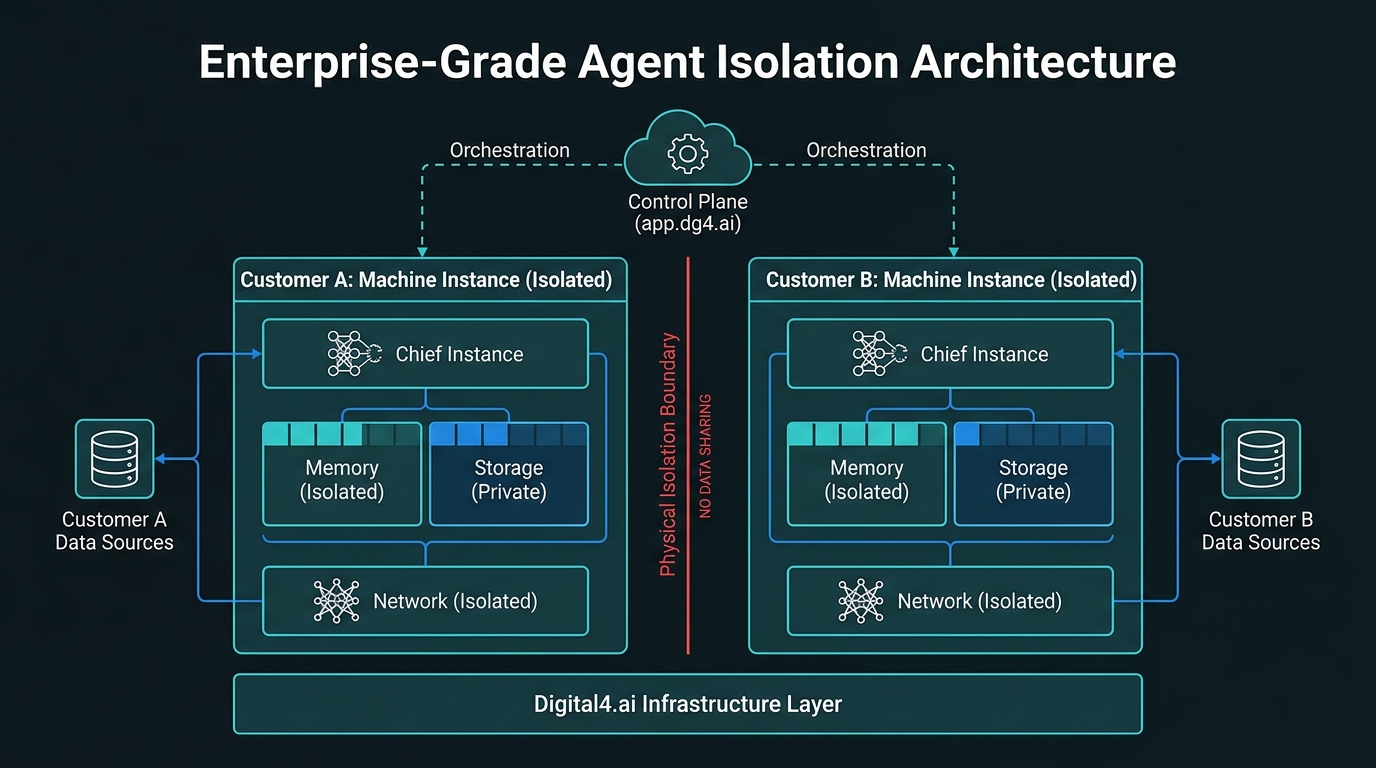
Physical isolation. Every customer's agent runs on its own dedicated infrastructure — not in a shared container, not on a multi-tenant VM, but on an isolated machine that exists only for that customer. When the agent runs, your data doesn't share memory, storage, or network with anyone else's agent.
We already do this. At Digital4.ai, every Chief instance is deployed as a dedicated container on isolated cloud infrastructure. Your agent doesn't share resources with other customers. It's not a namespace partition or a logical separation — it's a physically separate machine.
Behavioral sandboxing. Beyond physical isolation, the agent itself operates within defined boundaries:
- What it can access: Only the data sources you've explicitly connected
- What it can do: Only the actions defined in its soul template and skill set
- When it escalates: Defined uncertainty thresholds — if the agent isn't confident, it flags a human
- What it remembers: Customer context stays within the agent's memory — it doesn't leak into other conversations or other customers
Monitoring and threat detection. Our AgentGuard security layer monitors every agent interaction in real time. Network intrusion attempts, unusual data access patterns, unauthorized action attempts — all logged, all alertable, all auditable.
This isn't a feature. It's a requirement. Any AGaaS provider that can't explain how they isolate your data and sandbox agent behavior is asking you to take a risk that no enterprise should accept.
The Jevons Paradox of AI: Why Cheaper Means More
Jensen Huang referenced the Jevons Paradox at GTC — a 19th-century economic principle that says when the cost of a resource drops, total consumption increases rather than decreases.
Applied to AI: as inference costs collapse (tokens are trending toward free for many models), businesses won't use less AI. They'll use dramatically more. Every customer interaction. Every email triage. Every scheduling request. Every follow-up. Every report.
The metric Jensen says will matter most: tokens per watt = revenue.
For SMBs, this means the window for "wait and see" is closing. Your competitors aren't waiting. The businesses that deploy AGaaS first will:
- Respond to leads 24/7 while you respond during business hours
- Follow up automatically while your leads go cold
- Scale customer service without scaling headcount
- Operate consistently while your team has good days and bad days
The cost is collapsing. The technology is ready. The security frameworks exist. The only remaining question is: who in your industry will move first?
How to Adopt AGaaS Without a Seven-Figure Budget
You don't need an enterprise contract, a team of ML engineers, or a data center. Here's the practical path:
Step 1: Define the role, not the technology
Don't start with "we need AI." Start with "we need someone to handle customer inquiries 24/7" or "we need someone to triage support tickets" or "we need someone to follow up on cold leads."
AGaaS works best when you think about it like hiring — what's the job description?
Step 2: Ship with process built in
This is where most AI agent deployments fail. They deploy a model without defining:
- What personality should the agent have?
- What does it know (and not know)?
- When should it act autonomously vs. escalate to a human?
- What are its communication boundaries?
At Digital4.ai, every Chief ships with a soul template — a complete operational profile that defines personality, expertise boundaries, domain knowledge, escalation rules, and communication style. You don't get a blank canvas. You get an agent that already knows how to do the job.
Step 3: Start small, scale fast
Deploy one agent for one role. Measure the results. Add agents as you see ROI.
Our customers typically start with a customer service or lead qualification agent at $149/month. That agent operates 24/7 across Telegram, email, and web chat. When it works (and it does), they add sales agents, scheduling agents, onboarding agents — building a roster, not just hiring one person.
Step 4: Never compromise on security
Your agent handles customer data. It represents your brand. It makes decisions on your behalf. If the platform you choose can't answer "how is my data isolated?" with a specific, technical answer — not marketing language, a real answer — keep looking.
The Bottom Line
Jensen Huang didn't invent AGaaS. But when the CEO of a $3 trillion company tells the world that every SaaS company will become an AGaaS company, it's worth paying attention.
The shift is already happening:
- Anthropic launched Claude Cowork Dispatch — a personal AI agent that acts on your behalf from your desktop and phone
- Microsoft built Copilot Cowork with Anthropic for autonomous task delegation
- NVIDIA released NemoClaw for enterprise agent security and open-sourced the Nemotron model family for commercial use
- OWASP published the first security framework specifically for autonomous agents
The question for your business isn't whether AGaaS is coming. It's whether you'll be the one deploying it — or the one competing against someone who already has.
Ready to See AGaaS in Action?
The Chief is your Agent as a Service. It ships with the process layer built in — soul template, domain knowledge, escalation rules, and enterprise-grade security from day one.
- 150+ pre-built roles across customer service, sales, operations, and more
- Dedicated, physically isolated infrastructure per customer
- AgentGuard security monitoring on every interaction
- 48-hour free trial — live in hours, not weeks
Launch offer: Use code FOUNDER100 for 3 months free — limited to first 100 customers.
Not sure which role to start with? Browse our catalog of 150+ ready-made Chief configurations and find the one that fits your business.
This article is Part 4 of our Innovation Lab: AI Technology series. Part 3 covered the technical and strategic reasons behind NVIDIA's dominance in AI. Next in the series: how open-source AI models are reshaping the economics of enterprise intelligence.
David Gassier is the CEO & CTO of Digital4.ai, where he builds AI agents that actually work for small and mid-sized businesses. Previously, he led technology teams delivering enterprise solutions for Fortune 500 companies. He writes about AI infrastructure, agent security, and the future of work.